The framed heirloom passed down through my mother, Charlotte née Grill, holds three objects from the same Östergötland family: a folded letter, a cut-paper silhouette, and a later studio photograph. The letter was written in early 1823 by the elderly clergyman Sven Lidman (1754–1823) to his daughter-in-law Ebba Lidman, née Annerstedt, in Linköping.
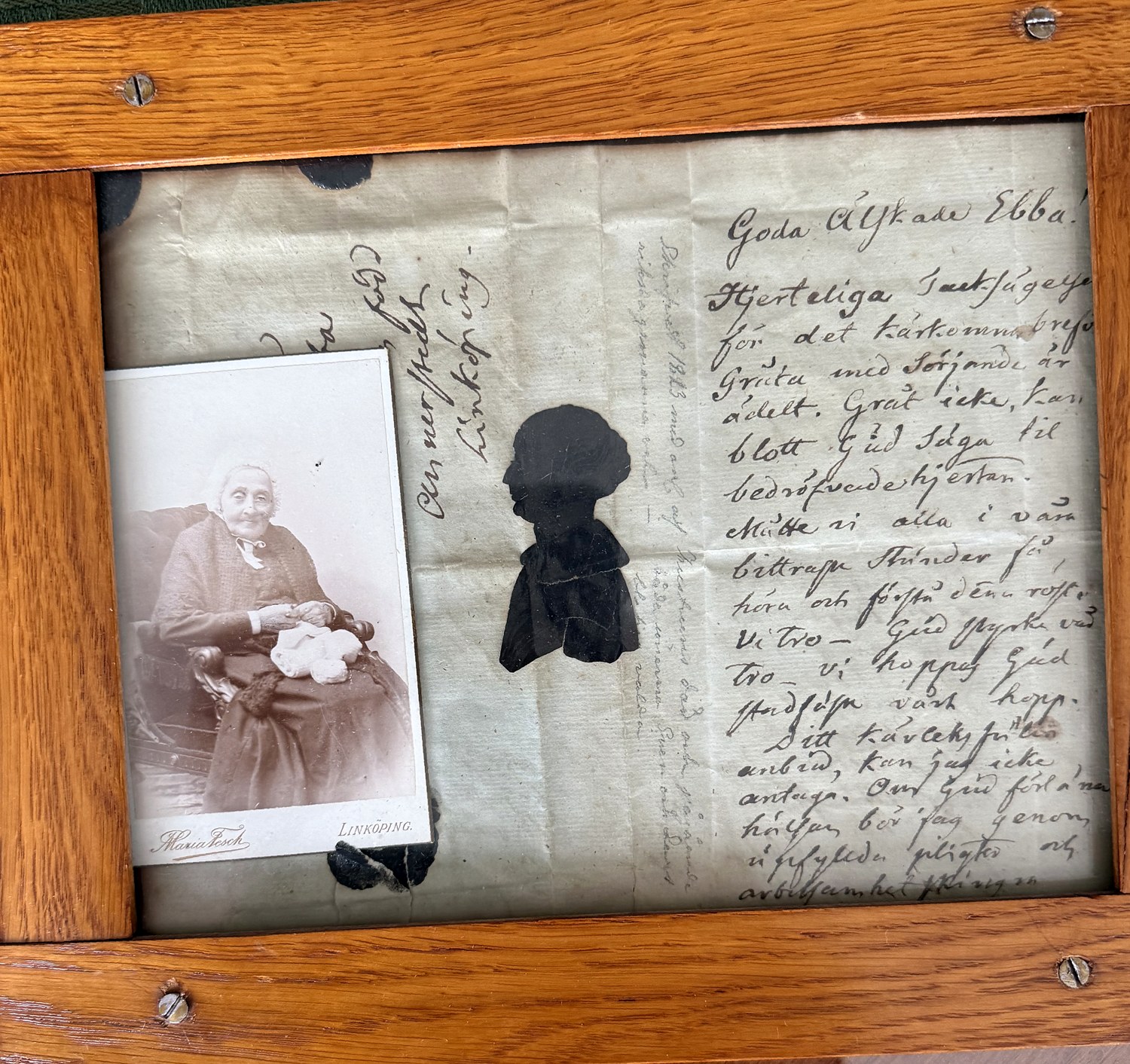
The framed heirloom — the 1823 letter, a cut-paper silhouette and the later photograph, mounted together.
The framed heirloom
Behind the glass, the single sheet of the letter is mounted open. Laid over it are two further family keepsakes: a black cut-paper silhouette (a profile portrait, a popular keepsake of the early 1800s) and a sepia cabinet-card photograph of an elderly woman. The two were almost certainly brought together by a later descendant, so that letter, silhouette and photograph could be kept and displayed as one piece of family memory. The photograph bears the studio mark Maria Tesch, Linköping (Nygatan 46), dating it to roughly the 1890s–1900s; the sitter is most likely a daughter or descendant rather than Ebba herself (d. 1868) — a strong candidate being the domprost’s eldest daughter, Henriette Charlotta Lidman, m. Grill (1825–1906).
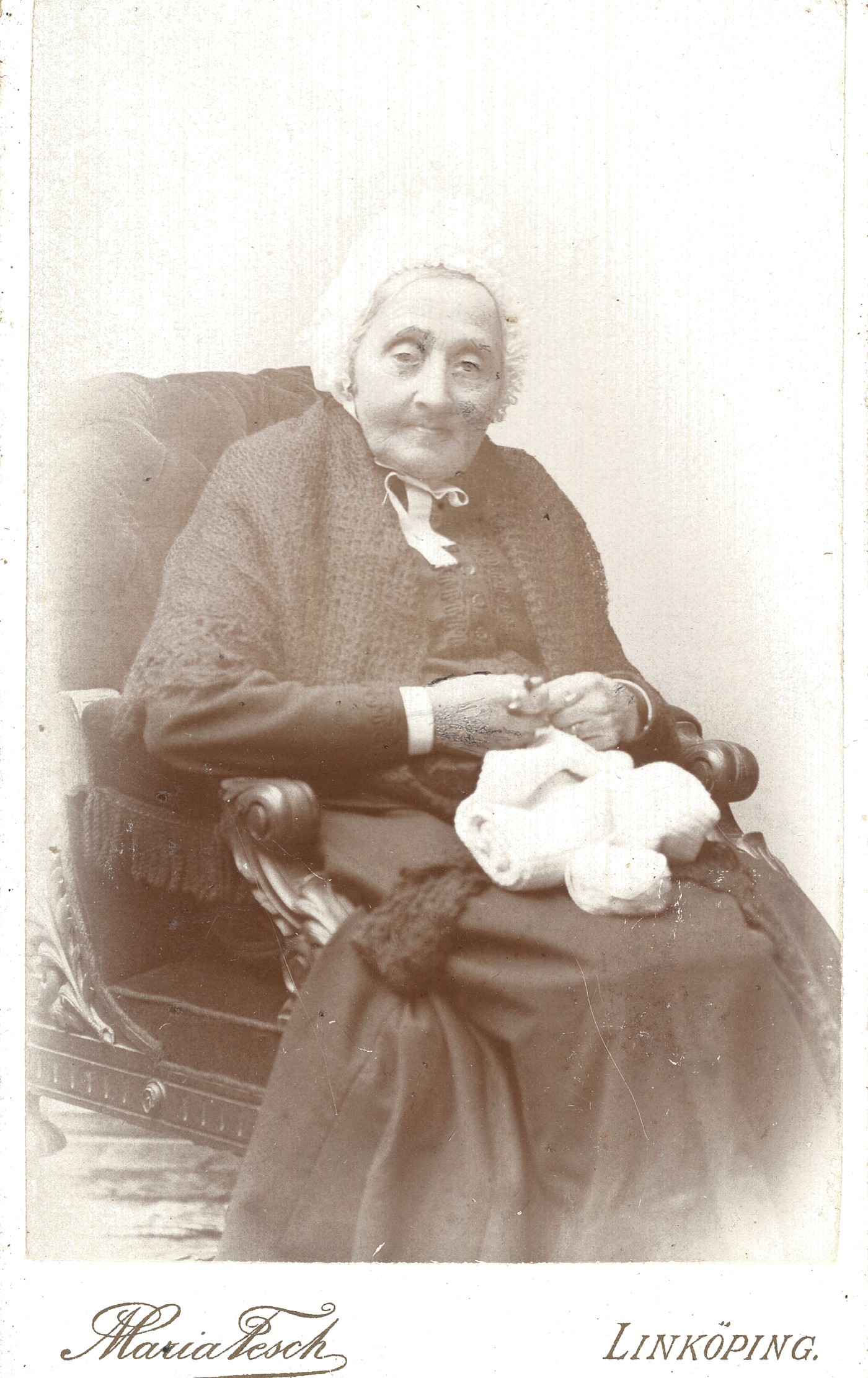
The cabinet-card photograph (Maria Tesch, Linköping) — most likely Henriette Charlotta Lidman, m. Grill (1825–1906).
Swedish transcription
Words still uncertain are given in [square brackets]; 19th-century spelling is kept as written.
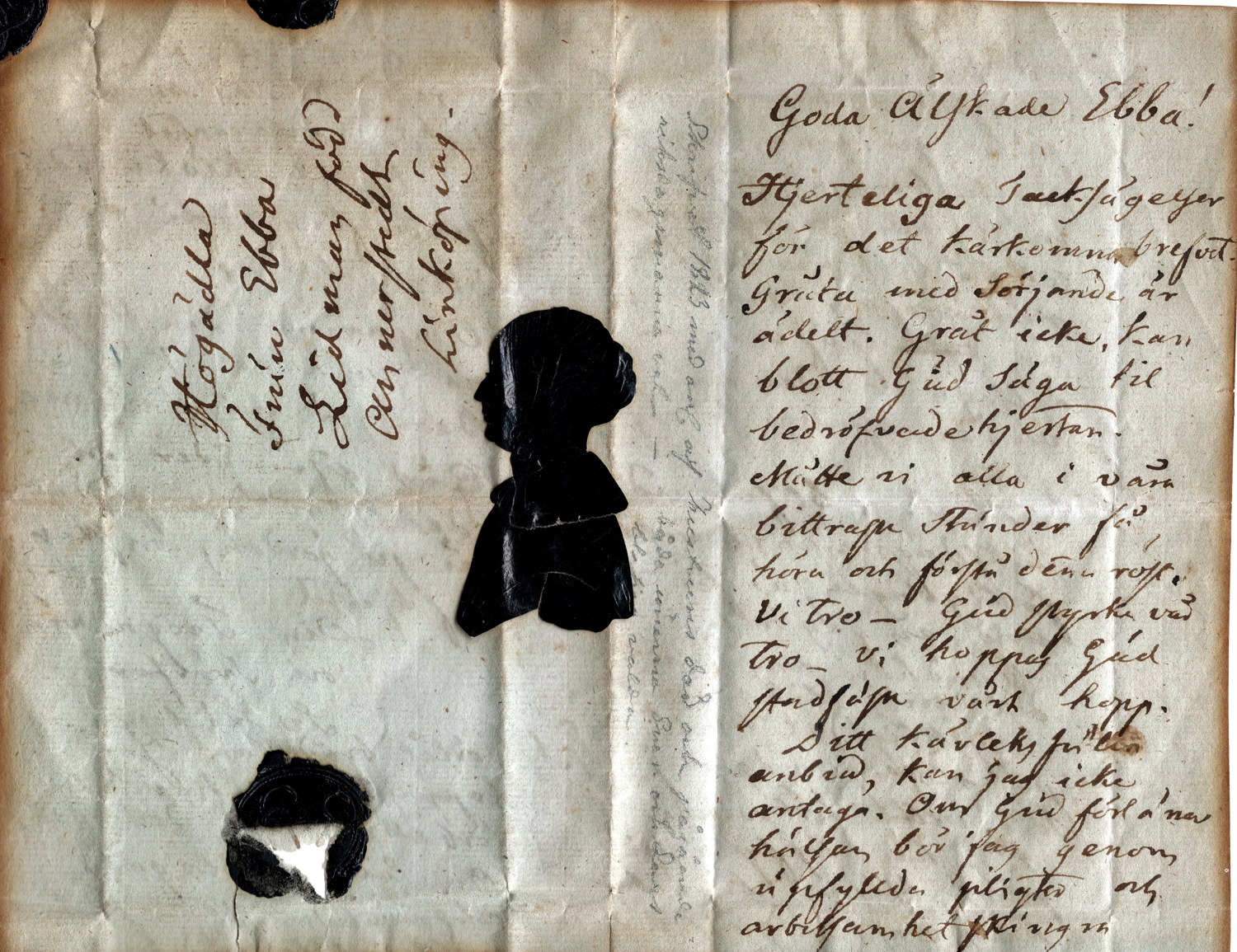
The letter, outer sheet: the address to Ebba, the cut-paper silhouette, a mourning wax seal, and the opening lines.
Address panel:
Högädla / Fru Ebba Lidman / född Annerstedt / Linköping.
Later pencil note (added by a descendant):
Skrifvet d. 1823 med anl. af riksdagsmannavalet — [… Sven och Lars …]
The letter:
Goda Älskade Ebba!
Hjerteliga Tacksägelser för det kärkomna brefvet. Gråta med Sörjande är ädelt. Gråt icke, kan blott Gud [tala] till bedröfvade hjertan. Måtte vi alla i våra bittraste Stunder få höra och förstå den rösten. Vi tro — Gud styrke vår tro — vi hoppas, Gud stadfäste vårt hopp.
Sitt kärleksfulla anbud kan jag icke antaga. Om Gud förlänar hälsan, bör jag genom uppfyllda pligter och arbetsamhet söka [lindra] mina bekymmer.
Tingstad[s Sterbhus] är det ställe på jorden, hvarest jag tillbringat mina [bästa] och gladaste dagar. Att på bortgångna vänners grafvar gråta är ljufvare än [att] deltaga i denna verldens ostadiga förnöjelser.
Att Sven blifvit vid Riksdagsmannavalet förbigången, är för mig en fägnad. Hvad honom angår, är det mig likgiltigt. Lyckligt att han på oloflige vägar ej sökt detta förtroende. Kan han uppfylla sin pligt, blifver lugnet hans vinst. […] tjenar han icke på denna resa. Någon mera utbildad erfarenhet kan han då [vinna]. Kloka rådgifvare finnas, då de ärligt sökas.
Omfamna din [äkta] maka och kära Barn på mina vägnar. Gud gifve Eder [och dem] [all den] glädje [som] är på jorden, [det] önskas af [hela mitt] hjerta.
Din Trogne vän och Svärfar — Sv. Lidman.
P.S. Förlåt brådskan. Jag hoppas kunna framdeles förbättra dessa fel. Om [Calles] skolgång och framtida vistande […]
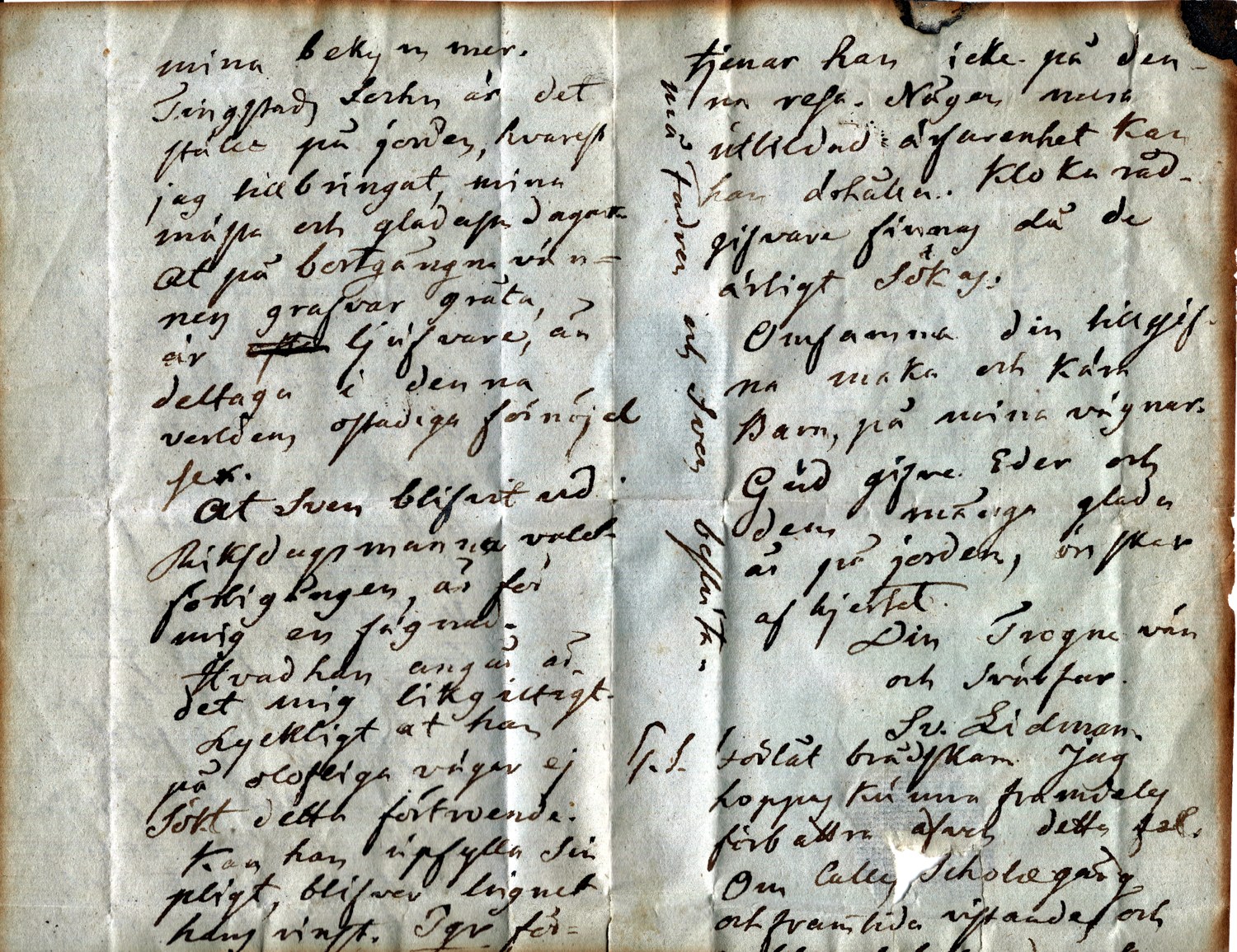
The letter, inner spread: the continuation and the signature, “Sv. Lidman.”
English translation
My dear, beloved Ebba,
Heartfelt thanks for your most welcome letter. To weep with those who mourn is a noble thing. Do not weep — only God can [speak] to grieving hearts. May we all, in our bitterest hours, be granted to hear and understand that voice. We believe — may God strengthen our faith — we hope, and may God confirm our hope.
Your loving offer I cannot accept. If God grants me health, I ought, through the faithful doing of my duties and through honest work, to seek to [ease] my cares.
Tingstad is the one place on earth where I have spent my best and happiest days. To weep at the graves of departed friends is sweeter to me than to share in this world’s fickle pleasures.
That Sven has been passed over in the election to the Riksdag is, for me, a relief. As far as he himself is concerned, it leaves me indifferent. It is fortunate that he did not seek this office by improper means. If he can do his duty, peace of mind will be his reward. […] he gains nothing by this undertaking; he may at most gain some wider experience from it. Wise counsellors are always to be found, when they are honestly sought.
Embrace your dear husband and beloved children on my behalf. May God grant you all the joy that is to be had on this earth — this is wished with all my heart.
Your faithful friend and father-in-law — Sv. Lidman
P.S. Forgive the haste. I hope to make good these faults another time. Concerning [Calle’s] schooling and where he is to live in future […]
Who wrote it, and to whom
The signature “Sv. Lidman” and the closing “Your faithful friend and father-in-law” (Swedish Svärfar) identify the writer precisely. The only Sven Lidman who was father-in-law to an Ebba née Annerstedt was Sven Lidman (1754–1823), born in Flisby, parish priest (prost; earlier komminister in S:t Johannes parish, Norrköping), who in his last years lived at — and died at — Tingstad, just outside Norrköping. That is exactly the place the writer calls “the one place on earth where I have spent my best and happiest days.”
The recipient is his daughter-in-law, Ebba Margareta Annerstedt (1798–1868), who in 1820 married the writer’s son Sven Fredric Lidman (1784–1845) — the future domprost (cathedral dean) of Linköping, member of the Riksdag, and one-time legation chaplain and traveller in the Ottoman East. The “Sven” spoken of in the third person — the one passed over in the election to the Riksdag — is the writer’s son, Ebba’s husband. The old father is frankly relieved that his son will not be sent to Parliament. The child “Calle” in the postscript is most likely the couple’s first-born, Carl Lidman (b. 1821).
The letter’s emotional heart is a refusal. The “loving offer” (Sitt kärleksfulla anbud) that Sven declines was almost certainly an invitation from Ebba and her husband to leave Tingstad and be taken into the family’s care in Linköping. The aging, ailing father gently refuses: while health allows, he would rather support himself through duty and work, and remain at the Tingstad he loved — where, as he writes, weeping at departed friends’ graves is sweeter to him than sharing in this world’s fleeting pleasures. (The polite 1820s “Sitt” here is a deferential form of “Your.”)
Dating the letter
A later hand pencilled “Skrifvet… 1823 med anl. af riksdagsmannavalet” across the fold. The genealogy confirms it: the writer died in June 1823 and his son had married Ebba in 1820, so the letter falls between 1820 and June 1823. The reference to a riksdagsmannaval points to the elections for the Riksdag of the Estates that assembled in 1823. The letter was therefore written in the early months of 1823, shortly before the old man’s death — which lends the lines about graves, failing strength and “if God grants me health” their particular weight.
The wider family
This is the family later made famous by the author and revival preacher Sven Lidman (1882–1960), a great-grandson of the writer. Sven Fredric and Ebba had twelve children at Stora Torget 1 in Linköping. Among the daughters was Henriette Charlotta Lidman (1825–1906), who married Claes Grill. It is through this Grill line — Henriette Charlotta Lidman → Grill → my mother, Charlotte née Grill — that the framed letter has descended in our family. The writer’s younger son Lars Gustav Lidman took over the family farm Lilla Gullborg in Tingstad and sat in the Riksdag’s peasant estate.
The photographer
Hedvig Maria Tesch (1850–1936) opened her studio in Linköping in 1873 and became the town’s most prolific portraitist, working at Nygatan 46 until 1917. Thousands of her plates survive in the collections of the Östergötlands Museum. The reverse of the card carries her decorative trademark and the line “Plåten förvaras för efterbeställning” (“The plate is kept for re-orders”).
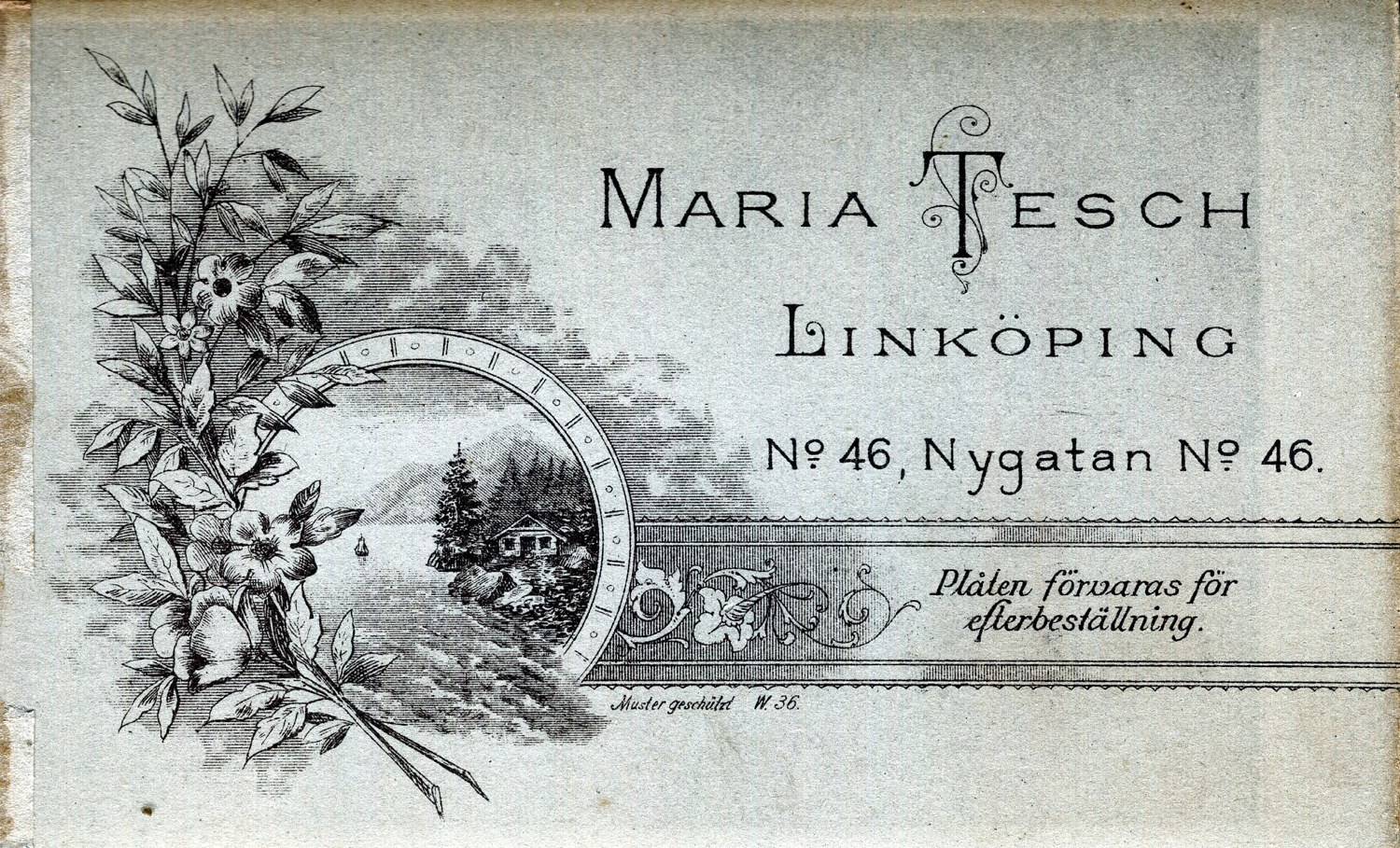
The decorative reverse of the cabinet card — “Maria Tesch, Linköping, No. 46 Nygatan.”
Open questions & notes
- A few words are still provisional (in brackets), notably [tala], [lindra], [vinna] and the postscript name [Calle].
- The identity of the woman in the photograph is inferred, not proven; Henriette Charlotta Lidman (Grill) is the leading candidate.
- The cut-paper silhouette’s subject is unidentified — possibly Ebba herself or another family member of the 1820s–40s.
Sources
- Lidmanarkivet — Biografi: Sven Lidman, 1784–1845
- WikiTree — Sven Lidman (1754–1823), d. Tingstad
- WikiTree — Sven Fredric Lidman (1784–1845)
- WikiTree — Henriette Charlotta (Lidman) Grill (1825–1906)
- Wikipedia — Sven Lidman (kyrkoman)
- Östergötlands Museum — Ateljéfotografen Maria Tesch